
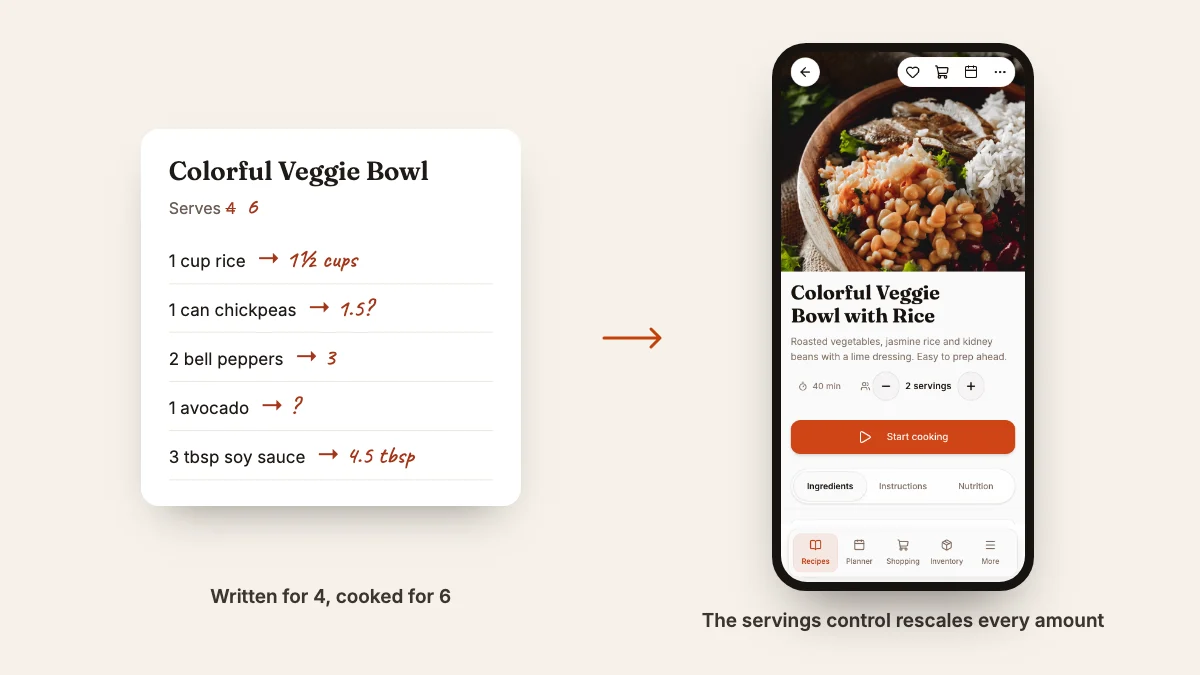
Why a scaled recipe can turn out too salty or undercooked
A recipe serves four and you are cooking for two, or for eight. Scaling looks like plain multiplication, but a few ingredients and steps do not follow the factor. These are the usual surprises:
The doubled stew tastes saltier than the original, because the salt was doubled too.
The doubled cake comes out with an odd texture, because the baking powder went up by the full factor.
A doubled batch crowds the skillet and steams instead of browning.
The cooking time was doubled along with the amounts, and the roast dries out.
Work out the factor
Divide the servings you want by the servings the recipe makes. Two portions from a four-portion recipe is a factor of 0.5. Doubling is 2. Multiply each ingredient by that factor.
For most ingredients (proteins, vegetables, grains, liquids) that is all there is to it.
Handle the ingredients that do not scale in a straight line
A few things need judgment rather than multiplication:
Salt and strong spices: use about three quarters of the factor, then taste and add more if needed
Leavening (baking soda, baking powder): scale with care, because too much ruins the texture
Oil for frying: you need enough to coat the pan, not a multiple of the original amount
Check the pan size as well
Double a recipe and it may no longer fit in one pan. A crowded skillet steams the food instead of browning it. Use a bigger pan or cook in batches so the food cooks the way it did at the original size.
Cooking times change less than you expect
Doubling the amounts rarely doubles the cooking time. A larger roast takes somewhat longer. A doubled pot of soup takes a little longer to come to the boil, and then simmers for about the same time. Go by temperature and texture rather than the clock.
Let a portion slider do the arithmetic
The easiest way to scale a recipe is to not do the arithmetic yourself. A portion slider recalculates every ingredient and updates the shopping list to match, so what you cook and what you buy line up.
Good to know
The servings control scales in a straight line and leaves spices, leavening, baking times and pan sizes alone. Use the advice above for those: about three quarters of the factor for salt and strong spices, then taste.
Ingredients without an amount in the recipe stay without one after scaling. Adjust them by hand while you cook, the way you would with salt to taste.
Frequently asked questions
Why is my doubled recipe too salty?
Salt and strong spices do not need the full factor. Use about three quarters of it, taste, and add more at the end if needed.
How do I scale a recipe to a different number of servings?
Divide the servings you want by the servings the recipe makes to get a factor, then multiply each ingredient by it. Most ingredients scale in a straight line. For salt and strong spices use about three quarters of the factor and adjust to taste.
Does cooking time change when you scale a recipe?
Less than you would expect. Larger amounts take somewhat longer to heat through, but simmer and bake times stay about the same. Go by temperature and texture instead of multiplying the time.
Do I need a bigger pan when I double a recipe?
Often, yes. A crowded skillet steams the food instead of browning it. Use a bigger pan or cook in batches, so the food cooks the way it did at the original size.
What is the easiest way to scale a recipe?
Use a recipe tool with a portion slider. It recalculates the ingredients and updates your shopping list, so you skip the math and the amounts you buy match the amounts you cook.